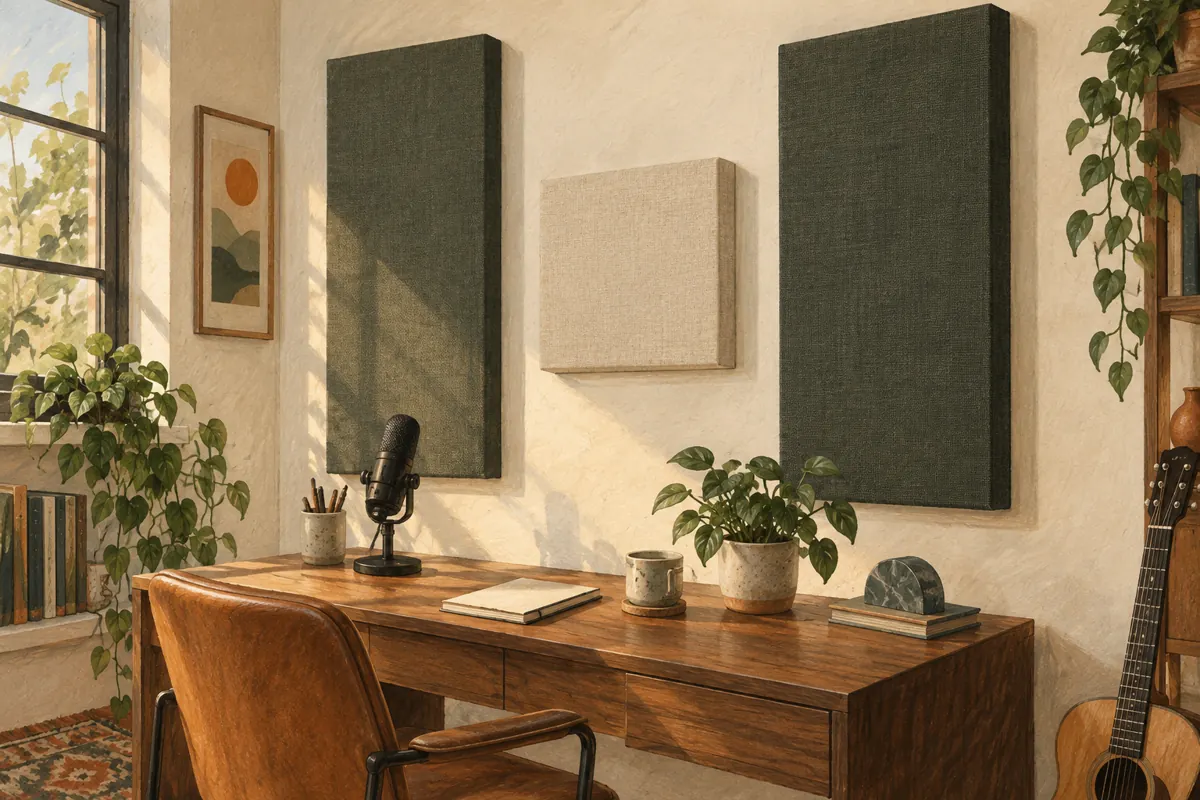
A room can make a good voice hard to follow. Bare walls send each word back at you. Put a microphone in that space and it hears the room too. Acoustic panels help by soaking up some of those reflections.
I would choose panels by the sound problem first, then by the look. A thin panel for speech and a deep bass trap do different jobs. Buying the wrong type in a nice color still leaves you with the wrong type.
These three acoustic panels suit home offices, small recording spaces, and rooms used for calls or listening. Each has a clear use. None earns its place by claiming to stop all noise.
| Panel | Why I would choose it |
|---|---|
| GIK Classic Acoustic Panel | Speech, side-wall reflections, and a choice of shapes |
| ATS 24 x 48 x 2 | A framed wall panel with published test data |
| Audimute Anchorage | A slim fabric panel for shared living and work spaces |
1. GIK Classic: my first choice for speech
The GIK Classic Acoustic Panel is a 2-inch fabric-covered panel. It comes in square, narrow, portrait, and rectangular shapes. That lets you treat a small wall. The whole space need not look like a recording booth.
It works best on midrange and high sounds. Think speech, claps, and the sharp ring between bare walls. I would place these acoustic panels where they catch early reflections around a desk or listening seat.
I also like that GIK offers room advice. Unsure where to start? A room plan beats a guess based on a photo of someone else's studio. Send the room size and say what you hear. Ask where to start, not just how many panels to buy.
Where it falls short: this slim panel is not my choice for a deep bass problem. Does one low note boom while the next seems to vanish? Check where the speakers and seat sit. Then look at thicker bass treatment. A wall of 2-inch panels can dull speech while the low end still rings.
For a podcast desk, I would start with a few well-placed panels and listen again. There is no prize for covering every wall. The aim is a clear voice with less room around it, not a room that feels oddly airless.
2. ATS 24 x 48 x 2: a straightforward wall panel
The ATS 24 x 48 x 2 acoustic panel uses a mineral-wool core, a wood frame, a wood back, and a fabric cover. ATS lists its weight at about 12 pounds. Wall clips, screws, and anchors are included.
I would choose it for a plain rectangular layout in a room where sturdy edges matter. The frame helps the panel keep its shape, while the large face covers a useful patch of wall. I like it for a row of panels around a desk.
I trust a test table more than a broad claim of better sound. It shows much less absorption at 125 Hz than at higher bands. That is a useful clue: this panel is built to help with speech and reflections, not to act as a cure for deep bass.
Where it falls short: the solid back and weight affect placement. Use the stated wall mounting method and anchors suited to your wall. Do not hang a heavy wall panel above a chair with improvised string or a few adhesive strips.
Check the chosen fabric and fire rating if the panel is going in a shared building. A brand name alone does not tell you that every finish has the same rating. The panel, fabric, and mounting plan all need to suit the space.
3. Audimute Anchorage: a slim finish for a shared room
The Audimute Anchorage fabric panel has a 1.5-inch profile and a recycled cellulose-based core. The range offers several sizes and fabric colors, which helps when acoustic wall panels must fit around shelves, art, or a video-call backdrop.
This is the pick I would look at for living rooms and home offices where the finish matters as much as the shape. A neat group of acoustic panels can sit comfortably among the things already in the room.
Audimute lists an NRC of 0.95. That rates sound absorption across a few bands in a lab. It does not mean the panel blocks 95 percent of all sound through a wall. That distinction is vital if a seller uses the words noise reduction without saying what noise they mean.
Where it falls short: the shallow depth limits what I would expect from it at low frequencies. Treat it as a speech and echo tool. For a bass-heavy music room, ask for the full test data and a room plan before you order a large pack.
I would get a fabric sample before filling a visible wall. Screen colors vary, and a rough texture can look quite different in side light. Measure the whole layout, including the gaps between acoustic panels, before choosing sizes.
Acoustic panels and soundproofing do different jobs
Sound absorption panels act on sound inside a room. They take in some of the energy that would otherwise bounce off hard surfaces. You hear fewer overlapping reflections, so speech can sound clearer.
Soundproofing deals with sound getting into or out of the room. That may call for changes to gaps, doors, walls, floors, or the structure itself. A few soft wall panels do not turn a thin wall into a heavy one.
This is why acoustic panels may help a call sound less hollow but do little about a truck outside. They can reduce echo from voices in conference rooms. They cannot promise that the next room will no longer hear those voices.
Is the noise from traffic, footsteps, or a neighbor's music? Find how it gets in first. If your own voice rings around bare walls, sound absorbing panels are a more direct fit. Both problems can exist in one room.
For home recording, fix simple faults first. Get close to the mic, move away from a bare corner, and quiet a loud fan. Our podcast equipment guide shows how mic placement and a basic setup work together.
What the sound absorption numbers actually tell you
NRC stands for Noise Reduction Coefficient. It sums up absorption at four test frequencies. It helps you compare panels at a glance. But it leaves out some key facts for a small music room.
The ATS guide to sound and fire ratings explains these measures. Look for the full chart, the tested thickness, and the way the panel was mounted. An air gap behind a panel can change the result.
A high NRC does not prove strong deep-bass control. Nor should you turn a lab number into a promise about the share of noise removed from your home. Sound behaves differently as room size, surfaces, placement, and the source change.
For speech, useful midrange absorption is often the goal. For music studios and home theaters, look farther down the frequency chart. Bass traps need enough depth, volume, and suitable placement to make a useful difference.
Core materials also vary. Fiberglass, mineral wool, recycled fiber, and foam can all absorb sound in the right design. Look at the whole panel and its test data. No raw material is always best.
How many acoustic panels do you need?
There is no honest one-number answer for every room. A small, furnished room may need little treatment. An empty room with glass and hard floors may need much more. The same six acoustic panels could be too much in one space and too little in another.
Start with the room dimensions, what you use it for, and where people sit. The GIK panel calculator can help frame a starting plan. Use it as a guide, then check the result in the actual space.
For a desk, focus on the nearby walls that send speech back toward the microphone. For speakers, first reflections at the side walls and ceiling are common places to assess. The wall behind the listening seat may matter too, especially if you sit close to it.
You can find a side-wall reflection point with help from another person and a small mirror. Sit in the listening spot. Have them slide the mirror along the wall. Where you can see a speaker in it is a candidate spot for treatment. This is a starting aid, not a full room test.
Recording studios often use several kinds of treatment together. That does not mean a home office needs the same layout. In conference rooms, speech across the whole room may matter more than one sweet spot. A large auditorium needs its own design, not a scaled-up shopping list.
Should you buy foam panels instead?
Foam is light and can help with high-frequency reflections. It can be useful in the right place. The problem is treating thin foam as if it were a deep bass trap or sound insulation.
Cheap foam packs are often sold by piece count. Check the size of each piece and its thickness. Lots of small foam tiles may cover less wall than you think. Read the fire information too, especially near heat sources or in public spaces.
I would not cover a room in thin foam just because the first clap sounds less sharp. You can lose high-end life while low notes still hang around. That leaves a dull room with a bass problem.
If you like wood slats, art panels, or walnut finishes, ask for data on the exact product and mounting method. A decorative surface may reflect sound, absorb some bands, or do both. A nice photo does not answer that question.
Install a small set, then listen again
Lay out the panel positions with paper or tape first. Check doors, switches, vents, and the view on video calls. Leave the space usable. Acoustic wall panels should not force you to sit in an awkward spot.
Use the maker's hardware and instructions. Wall mounting and ceiling mounting are different jobs. Eye hooks or wall clips alone are not a complete overhead mounting plan. For a ceiling panel, use hardware rated for that purpose and the actual ceiling structure.
Then repeat the same short voice recording from the same seat. Keep the mic, level, and distance the same. Listen for less ring between words. For bass, use room measurements or a careful sweep rather than judging by a hand clap.
If your microphone feeds a computer through an interface, keep those settings fixed too. Our USB audio interface guide explains the controls that can change your recording level.
I would stop adding acoustic panels when speech is clear and the room still feels natural. Spend the next dollar on the sound problem that remains. A well-placed pair can be more useful than a full wall treated without a plan.